23/09/2026
The art of the overcoat: how to put together elegant and comfortable outfits?
Every overcoat tells a story and serves a specific purpose. Whether it’s formal or casual, the key is to choose…
Before we talk about ‘made-to-measure’ and ‘bespoke’, we must first dispel a persistent myth: ‘half-measure’.
You’ve probably heard the term in a ready-to-wear shop. A sales assistant offers you “half-measure”, as if assuming that the buttonholes on a jacket’s sleeves were open. A rather lovely metaphor.
The problem? Half-measure doesn’t exist. It’s a meaningless marketing term. Or, at best, it’s akin to enhanced alterations to ready-to-wear garments. The garment already exists, cut to a standardised pattern, using pre-selected fabrics, and mass-produced industrially. It’s adapted to your measurements within the limits of what the garment allows, but it isn’t created specifically for you.
Calling it ‘half-measure’ is a marketing ploy. It plays on confusion to justify a higher price and give the illusion of a personalised service.
One might interpret this introduction as a form of snobbery, but the opposite is true. It is simply a matter of giving credit where credit is due.
Genuine bespoke tailoring begins where ready-to-wear ends. It is the creation of a garment specifically for you, based on your measurements, your choice of fabrics, and your preferences for cut and style. A garment that didn’t exist before you, and that will exist only for you.
Let’s get to the heart of the matter. Genuine tailoring is divided into “three distinct levels”, each with its own technical characteristics, manufacturing processes and target audiences.
It is essential to understand these differences. Not to establish a hierarchy of absolute value, but to know exactly what you are buying. To make an informed choice. To avoid paying the price of bespoke whilst receiving made-to-measure quality, or conversely, seeking a level of personalisation that made-to-measure is structurally unable to offer.
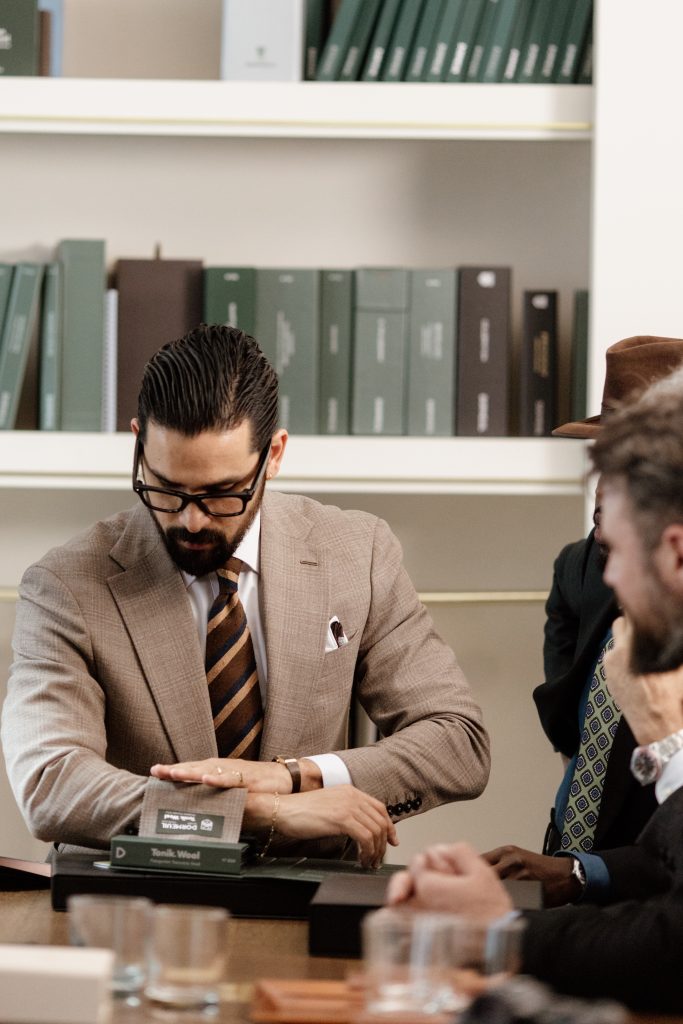
Made-to-measure, also known as industrial tailoring or MTM, is based on a precise technical principle: starting with an existing base pattern and adapting it to your measurements and personal preferences.
The garment did not exist before you placed your order. It is cut and assembled specifically for you, in the fabric you have chosen, according to your style preferences. However, rather than creating an entirely new and unique pattern, the process relies on tried-and-tested technical foundations which are adjusted to suit your body shape.
A reminder of the process:
Who is it for? Anyone who wants a suit that’s truly well-fitted, personalised to their aesthetic preferences, and offering excellent value for money and turnaround time. This is the true, smart, modern and efficient tailoring service.
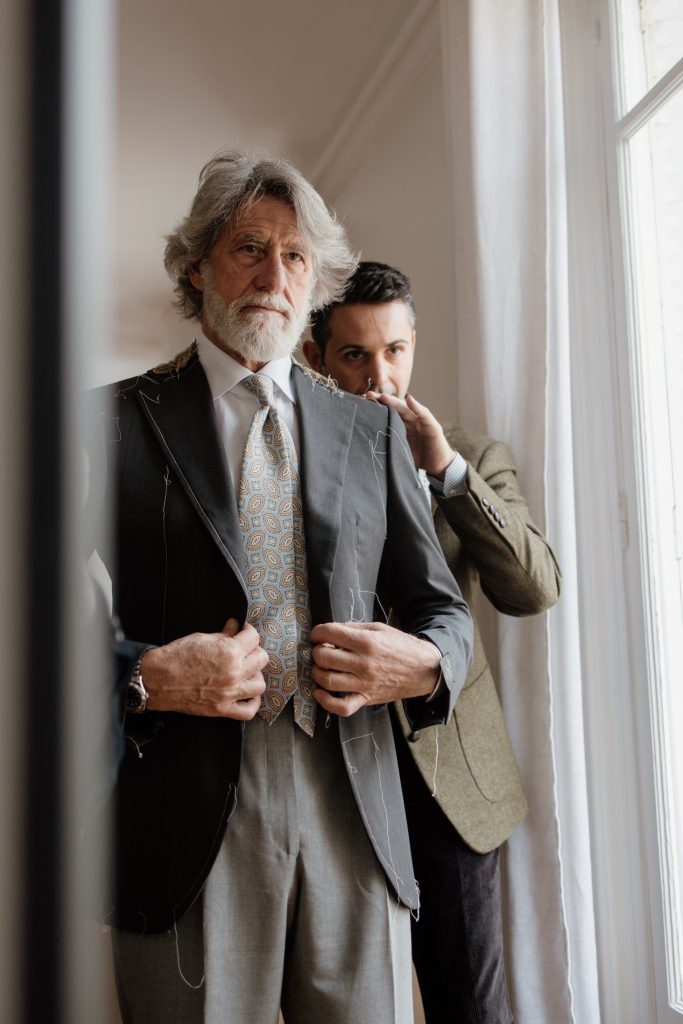
“Petite Mesure” sits in a transitional zone between made-to-measure and bespoke. It can take two forms depending on the workshop: industrial or artisanal.
A reminder of the process:
Industrial version:
Handcrafted version:
Who is it for? Anyone looking for greater precision than made-to-measure tailoring, who has a particular body shape requiring fine adjustments, but who does not want to (or cannot) go as far as bespoke tailoring. This is the right alternative.
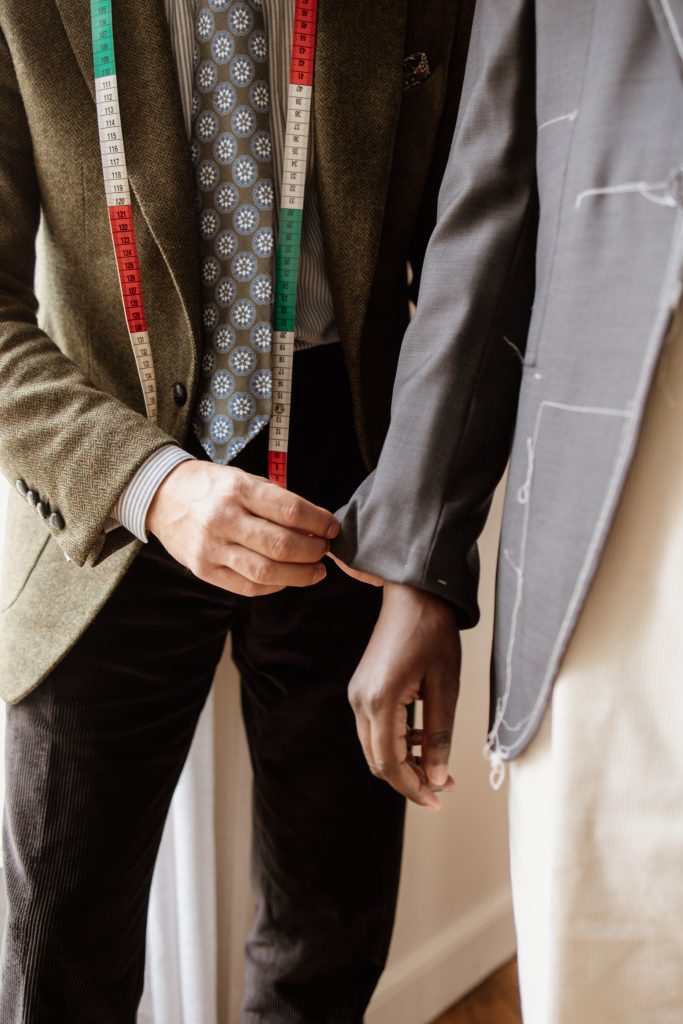
Bespoke tailoring, “bespoke” in English, represents the holy grail of sartorial craftsmanship. It is genuine tailoring in its purest, most demanding and most personalised form.
A reminder of the process:
Who is it for? Anyone with a very specific body shape that only a bespoke pattern can fit perfectly. Anyone seeking the pinnacle of craftsmanship, handwork and a personal relationship with a tailor. Anyone with the time and budget for this level of investment.
To understand where we are today, we need to go back a century.
Until the early 20th century, there were only two options: having a suit made by a tailor (the norm for the wealthy), or wearing second-hand clothing for the working classes. Ready-to-wear as we know it did not exist.
Then came the industrial era. The 1920s to the 1950s saw an explosion in standardised clothing production. Standardised sizes (S, M, L, then 48, 50, 52…), average cuts intended to suit ‘more or less’ everyone, and mass production that made suits accessible to the widest possible audience. It was a social revolution, but also the beginning of a certain degree of standardisation.
In the 1980s–2000s, in response to this standardisation, the ready-to-wear industry devised a compromise: systematic alterations.
But as already mentioned in the introduction, this period also marked something else: ready-to-wear gradually cannibalised the world of clothing. Not just in terms of market share – that was inevitable – but in the way men learnt to look at, understand and choose their clothes.
A certain appreciation of beauty was being lost.
It is this silent erosion that has made the invention of ‘made-to-measure’ possible. In a world where nobody really knows what genuine tailoring is anymore. In a world where clothing is now just another purchase amongst many, people no longer take the time to understand what they’re actually buying.
Emerging in the 1990s and 2000s thanks to technological advances (computer-aided pattern-making, specialist workshops in Eastern Europe and Portugal), it offers a radically different approach.
The logic is reversed: instead of starting with stock and adapting it, we start with your measurements and your choices to create a garment that does not yet exist. Nothing is cut until you place your order. Nothing is kept in stock. The suit is designed specifically for you, in the fabric you have chosen, according to your aesthetic preferences.
It is this philosophical shift that fundamentally separates two worlds: that of mass consumption, and that of accessible bespoke tailoring.
This historical distinction now takes on an additional dimension: environmental responsibility.
The ready-to-wear model relies on stock. To offer every size, every colour and every cut at all times, retailers must produce in bulk. Hundreds of identical suits, made from fabrics consisting mainly of synthetic blends.
In short, this entails structural overproduction. A colossal waste of materials, energy and labour.
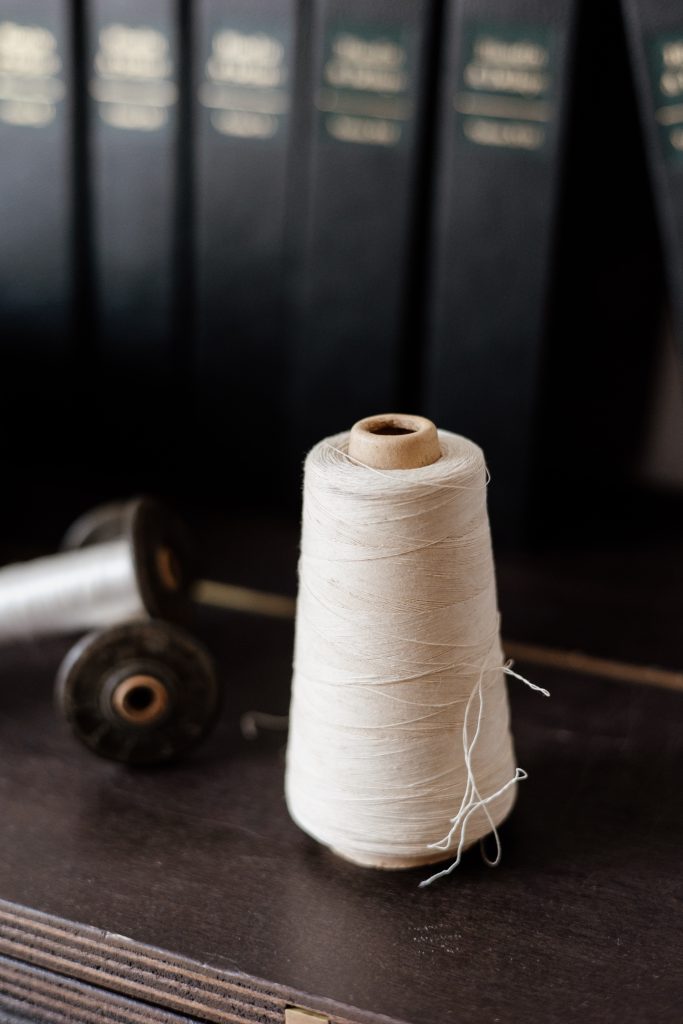
Nothing is manufactured until a customer places an order. No dormant stock. No surplus to clear. No ‘last year’s’ collection to sell off at a discount. Every suit cut meets a genuine need.
At Blandin & Delloye, this eco-responsible approach is not a marketing ploy. It is a logical consequence of our model. Industrial made-to-measure tailoring is, by its very nature, less wasteful than mass-produced ready-to-wear.
We only produce what is ordered. We work with European workshops that adhere to strict social and environmental standards.
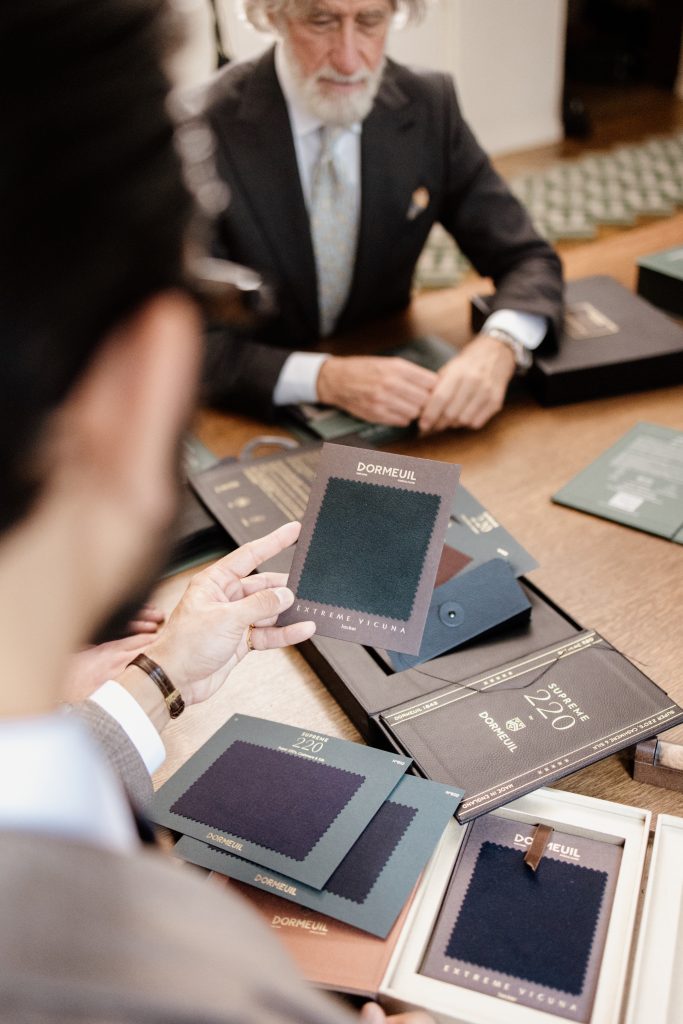
To understand why genuine bespoke tailoring holds such fascination, we must go back to its origins and realise that it was not always considered a ‘luxury ’. It was simply the norm.
Until the early 20th century, every man who wore a suit would visit a tailor. Not out of snobbery, but because there was no alternative. Clothes were made to measure, full stop. From princes to the middle classes, from dignitaries to wealthy shopkeepers, each according to their means, but all following the same artisanal process.
The tailor would take your measurements, draw up a unique pattern, cut the fabric, assemble the jacket by hand, and call you in for several fittings. It was time-consuming, it was demanding, but it was the only way to get dressed.
The major capitals had their own streets of tailors: Savile Row in London, Rue de la Paix in Paris, Via Montenapoleone in Milan. Family dynasties passed the trade down from generation to generation. Measurement books spanned decades – you could have your father’s suit remade exactly as it was twenty years later.
It was the golden age of bespoke tailoring. Not as an elitist luxury, but as a common practice for anyone who wore a suit.
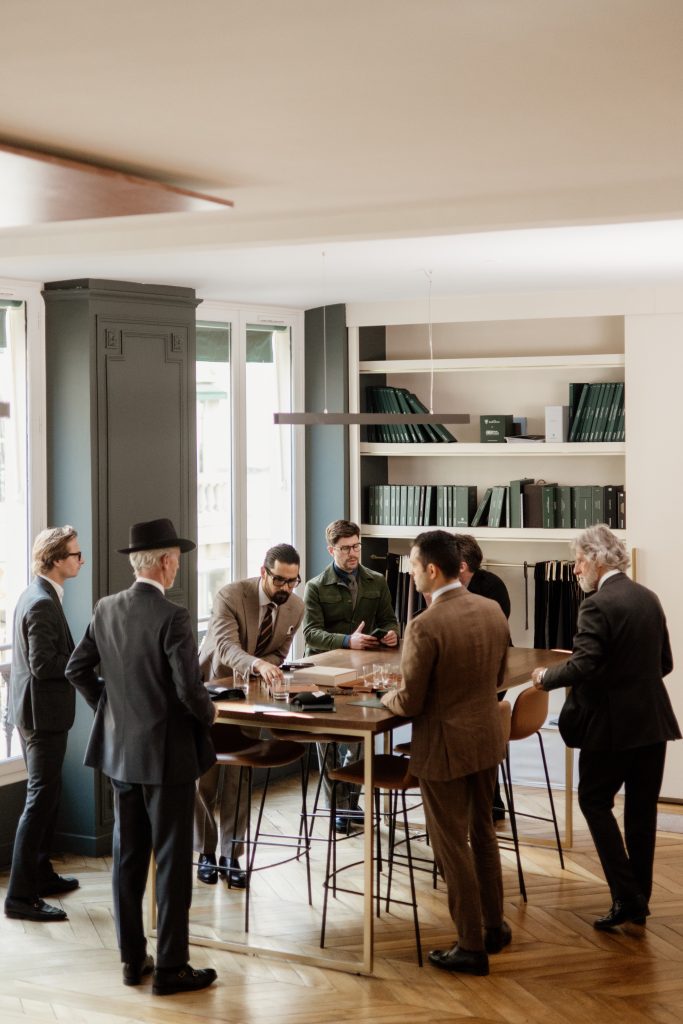
Then came the turning point. The 1950s to the 1970s marked the gradual collapse of genuine artisanal tailoring. Several factors converged: the explosion of ready-to-wear fashion, the disappearance of traditional craftsmanship, and changing lifestyles.
Within two decades, what had been the norm became a rarity. The great houses of Savile Row saw their clientele age and dwindle. Many disappeared. Those that survived positioned themselves to cater for an ultra-wealthy, international clientele, willing to pay a premium to preserve a tradition on the verge of extinction.
Paradoxically, the last twenty years have seen a resurgence of interest in bespoke tailoring. Not a massive comeback, mind you—we’re a long way from the volumes of yesteryear. But a new generation of discerning enthusiasts is rediscovering this craft. Specialist blogs (Parisian Gentleman, Permanent Style, The Rake) are educating an international audience. In addition, social media platforms are promoting craftsmanship and ‘handmade’ products.
Today, the historic houses are surviving. A few new workshops are springing up, driven by young, passionate tailors. But bespoke tailoring remains a niche market, with just a few thousand suits produced worldwide each year, compared to millions in ready-to-wear.
Let’s be honest: for far too long, bespoke tailoring has been seen as the preserve of an elite. We reject this view.
At Blandin & Delloye, we believe that any man who takes an interest in his wardrobe should have access to genuine bespoke tailoring. Accessibility does not mean compromising on quality. It means rethinking the process to make it more efficient without sacrificing what really matters.
It also means democratising knowledge. Explaining to you how a suit works, what determines its quality, how to choose your fabric, and why a particular cut suits your body shape better. You don’t need to be an expert to place an order with Blandin & Delloye – we’re here to guide you.
Our aim is simple: to make bespoke tailoring an accessible norm, not an intimidating luxury. Whether you’re 25 or 55, whether it’s your first suit or your tenth, whether you’re on a tight budget or have plenty to spare, you deserve a garment that truly fits you.
That’s what making bespoke clothing accessible is all about. And that’s precisely what well-executed industrial made-to-measure tailoring achieves.
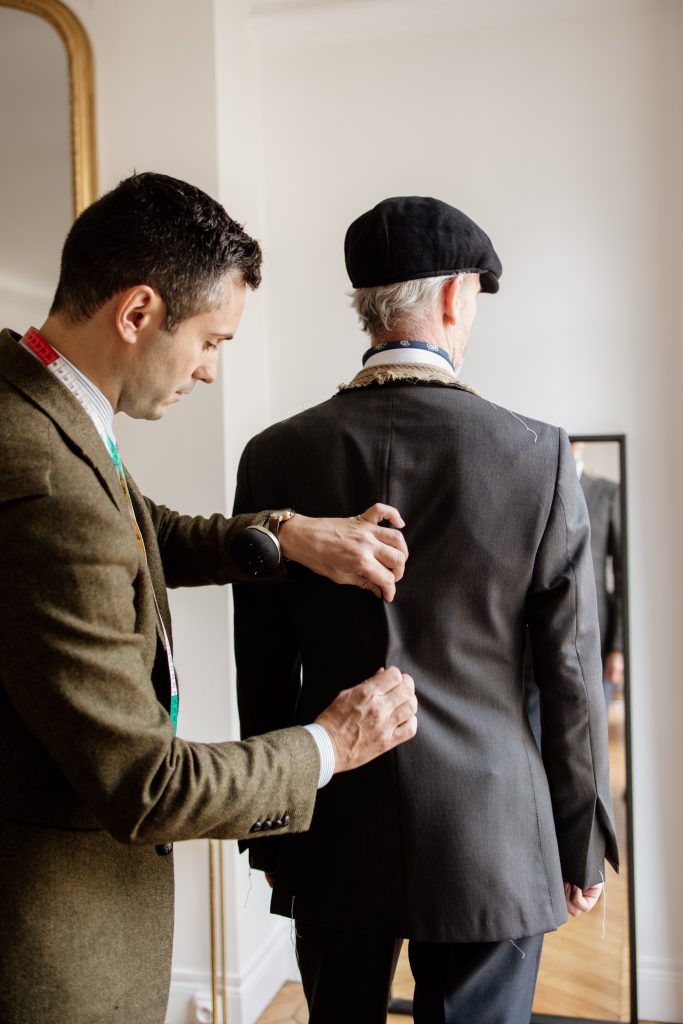
Author: @romain.pizzanelli