
29/10/2026
The Evening Ritual: Choosing Your Outfit the Night Before
"My day begins the night before at 10 pm, when I choose my outfit for the following day." Put like…
Situated in the valleys of West Yorkshire, the town has been one of the major centres of the British wool industry for several centuries. Its natural environment, particularly its rivers and the quality of its water, has fostered the development of the wool trade. This geographical setting was complemented by exceptional industrial expertise, passed down from generation to generation.
Over time, Huddersfield has thus become a leading centre for British worsted and cloth. This tradition has played a major role in supplying suits to London’s tailors on Savile Row and, more broadly, to connoisseurs of fine suits across the world.
At Blandin & Delloye, we are fortunate to work regularly with several of these houses. Some have become essential staples of our collections, and we also meet several of their representatives every year in Florence at Pitti Uomo, where the new collections and new fabric swatches are presented.
Here are a few of the names that help to explain what makes British fabric so unique.
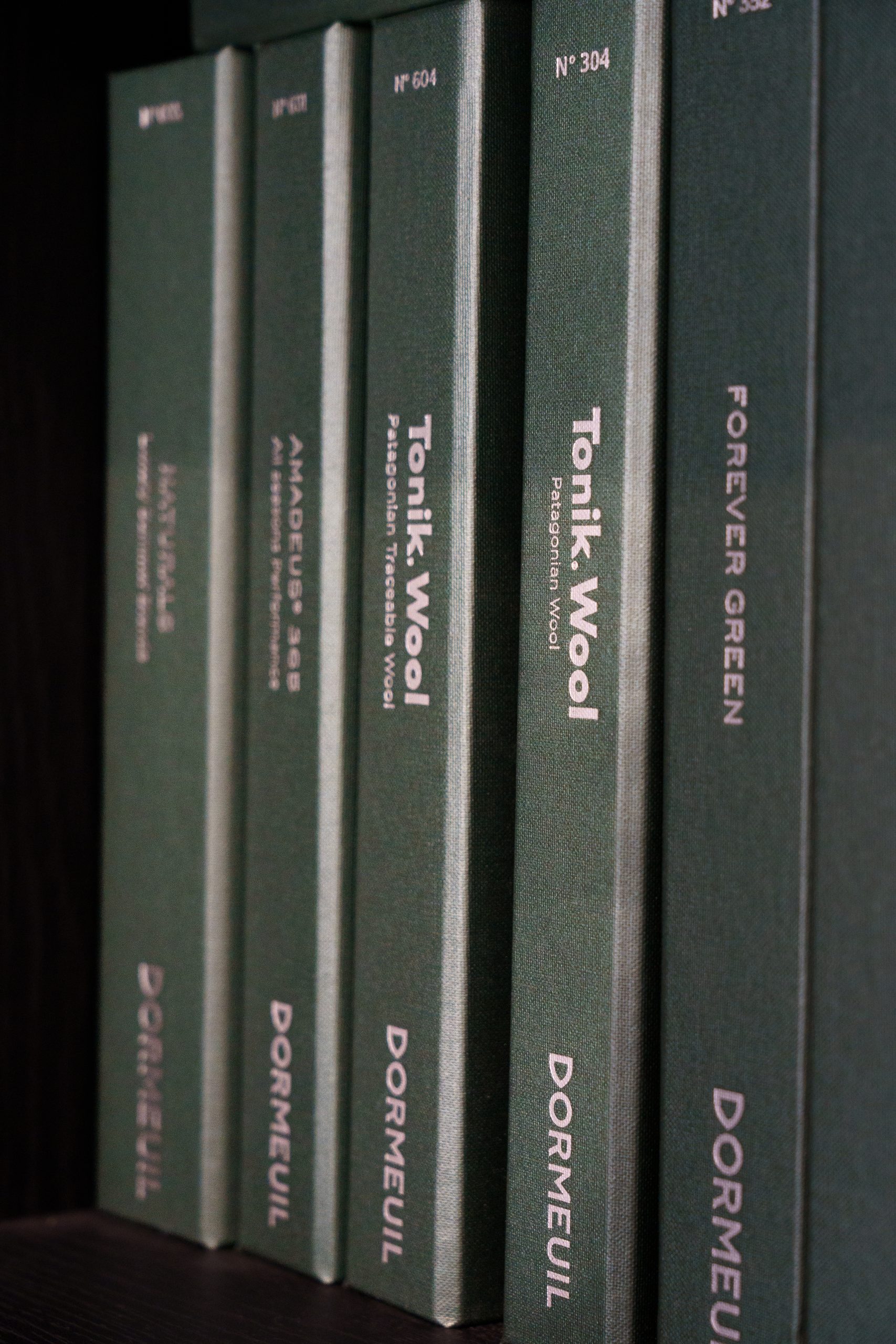
The history of Dormeuil forms an interesting link between France and England.
In the 19th century, men’s ready-to-wear was still a long way from occupying the place it holds today. To dress themselves, men mainly turned to their tailors, who selected their fabrics from specialist merchants.
It was against this backdrop that Jules Dormeuil founded his company in 1842. His idea was to import fine English fabrics into France so that he could supply them to French tailors. The business quickly became a success, and his brothers Alfred and Auguste joined the company. The house then adopted its famous coat of arms featuring three ram’s heads, symbolising the three brothers.
From its very earliest decades, Dormeuil developed a truly international reach. The company did not merely select the finest fabrics available: it gradually built up expertise in fibres and raw materials, seeking out new qualities and new possibilities.
This culture of innovation remains one of Dormeuil’s hallmarks to this day. The company works with materials sourced from different regions of the world and constantly seeks to combine textile tradition with fibre research.
Dormeuil is thus a rather unique case in this history: a French company whose journey began largely thanks to English bed linen, before going on to become one of the leading international names in men’s fabrics.
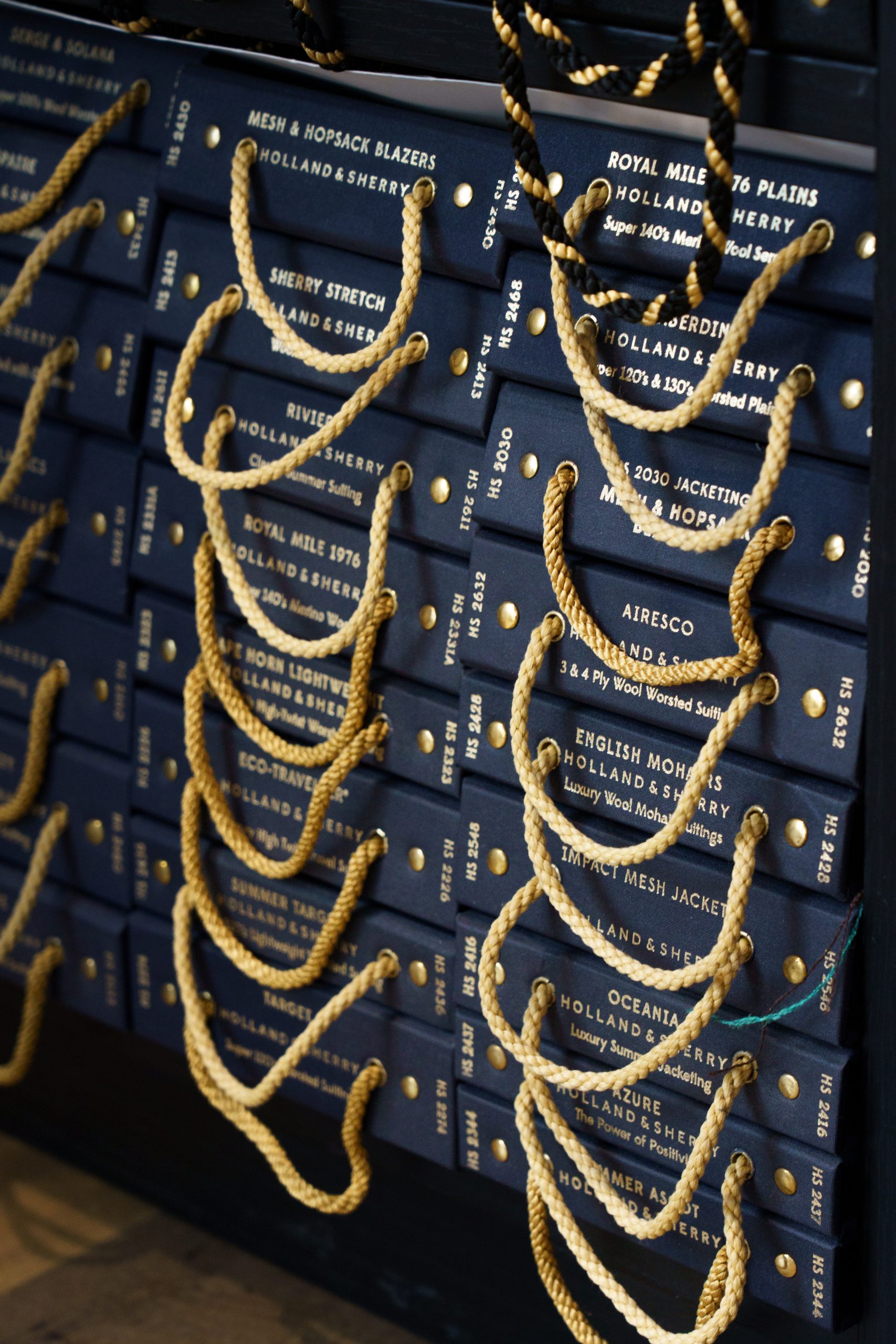
With Holland & Sherry, we enter another great tradition of British textiles: that of the London cloth merchant.
The story begins in 1836, when Stephen George Holland and Frederick Sherry joined forces as wool and fabric merchants in London. At that time, England was at the height of its industrial power and its textile industry was renowned throughout the world.
The firm gradually built up an international clientele and established itself amongst tailors and luxury fashion houses. In 1982, it moved to Savile Row, at the heart of one of the most iconic addresses in British tailoring.
Today, its range covers an exceptionally wide spectrum: fine wools, cashmere, silks, tweeds and numerous other fabrics for men’s and women’s clothing.
This diversity is precisely one of Holland & Sherry’s great strengths. The company is not solely associated with a single fabric or type of suit: it constitutes a veritable library of fabrics for clothing professionals.
And if there is one image that truly encapsulates the company, it is perhaps that of the Savile Row tailor selecting, from a stack of rolls, the fabric that will give character to his next suit.
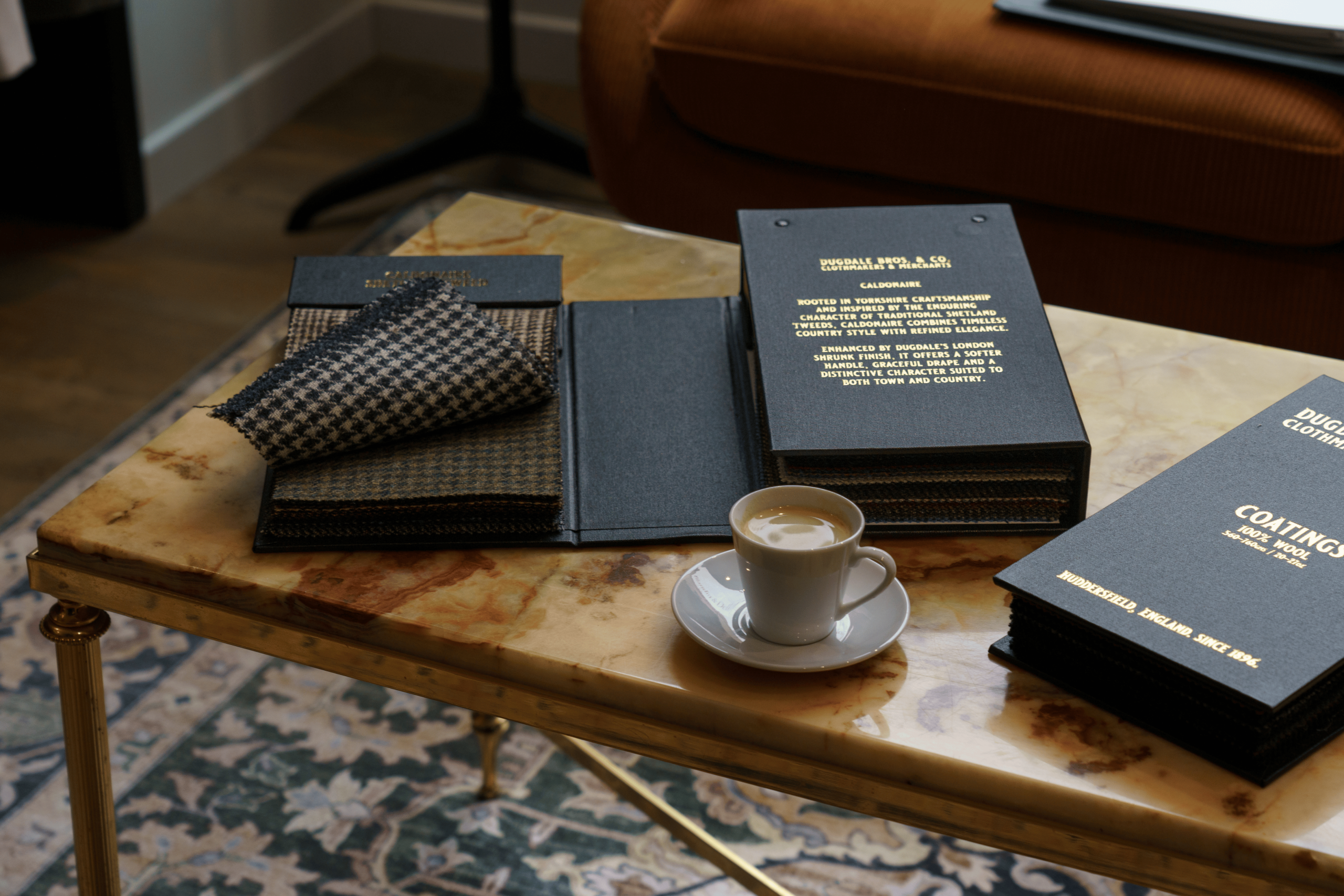
If one wishes to understand what Yorkshire still represents today in the world of tailoring, Dugdale Bros. & Co. is certainly one of the most interesting houses to discover.
The story begins in Huddersfield in 1896, when brothers Henry Percy and Frederick Herbert Dugdale set up their fabric trading business. At the time ,the town was at the heart of the British worsted industry , and fabrics produced in the region already had a significant international clientele.
More than 125 years later, Dugdale remains deeply rooted in its local area. The company is now the last independent clothmerchant in Huddersfield. Its collections are designed in-house and produced and processed locally, through a network of partners specialising in spinning, weaving and finishing.
It is this close connection to the local area that forms part of its appeal. Here, Yorkshire is not merely a place of origin claimed in a catalogue: it remains a genuine production environment.
At Blandin & Delloye, Dugdale is also a company we know particularly well. We work regularly with their fabrics and look forward to meeting their team every year in Florence at Pitti Uomo, when they present their new collections and fabric swatches.
Their work, moreover, captures the very essence of British fabrics: materials with structure, character and a distinctive depth, whilst keeping pace with evolving styles and silhouettes.
Today, Dugdale proudly champions this blend of tried-and-tested techniques and innovation, with collections ranging from great British classics to more original fabrics.
The name Huddersfield Fine Worsteds alone sums up the importance of this town in the history of the British textile industry.
But HFW above all tells another side of this story: that of historic firms whose legacies have been brought together over time under a single group.
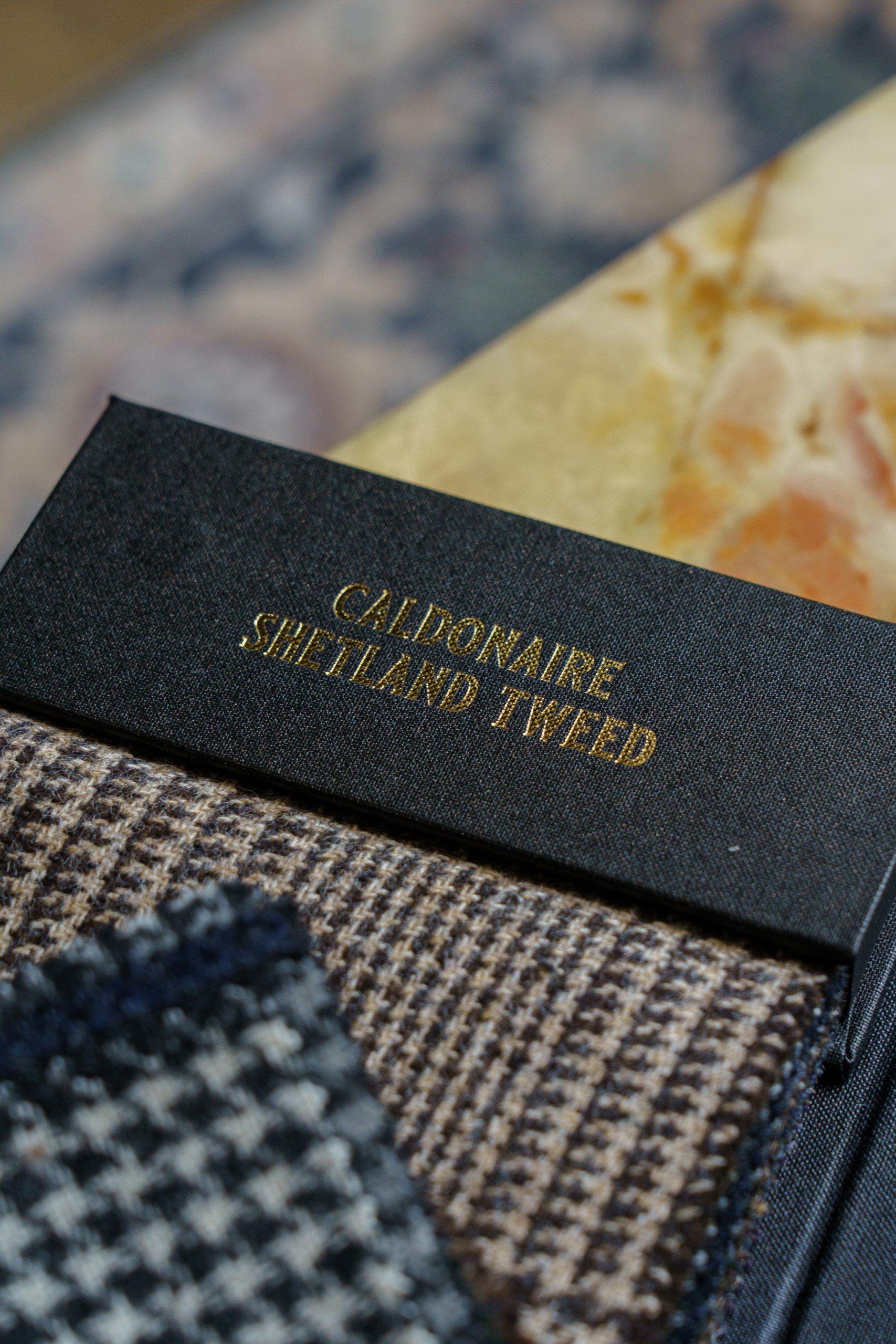
Among these names is Hardy Minnis, whose roots date back to the late 19th century. The firm has made a name for itself particularly in British fabrics for tailoring and in the world of tweed. It has also cultivated a long-standing relationship with the British Royal Family and has held a Royal Warrant since the 1930s.
HFW also carries on the legacies of several other historic houses, such as Hunt & Winterbotham and Martin Sons & Co., some of whose roots go back to the 19th century, or even much earlier.
This rich heritage is reflected in the collections on offer today. These include iconic British tailoring classics and a wide variety of fabrics designed for suits, jackets and the men’s wardrobe.
At Blandin & Delloye, HFW is one of the fabric suppliers with whom we work particularly regularly. And that is precisely what makes these collections so interesting: when looking through a swatch book, it is not simply a matter of choosing a colour or a pattern. Each fabric has its own history, construction, weight and drape.
The role of the consultant is therefore to bridge the gap between this wealth of textiles and the client’s actual needs: how they will wear the garment, their body shape, their environment and the way they wish to wear their suit.
Having discovered the great Italian drapers of Biella, a detour to Yorkshire ultimately reveals that there is no single way to create a beautiful fabric.
The great Italian houses have often built their reputations on the fineness, lightness, feel and a certain sophistication of the fabric.
The great British drapers tell a different story. That of a fabric which often possesses greater structure, body and character. A tradition born of a powerful wool industry and a craft that developed in the heart of the West Yorkshire valleys.
Two regions, two histories, two sensibilities.
And yet, one idea remains the same: a suit never begins with a jacket or a pair of trousers. It begins with a fabric.
It is the fabric that gives the garment its drape, its comfort, its personality and, over time, part of its elegance.
Author: @yves_dron