
In summary,
This two-piece tuxedo, with its off-white jacket featuring a shawl-collar and double-breasted design, is designed for grand summer evenings, open-air galas and summer ceremonies: a garment that looks just as good under the lights of a gala venue as it does under the night sky.
The tuxedo as a whole
The composition
The jacket and trousers are made from 100% wool barathéa fabric by Dormeuil, ivory for the jacket and black for the trousers. The tight twill weave creates a dense, matt surface that is crease-resistant, with a very straight drape that maintains the garment’s structure no matter how long the evening lasts.
The cut
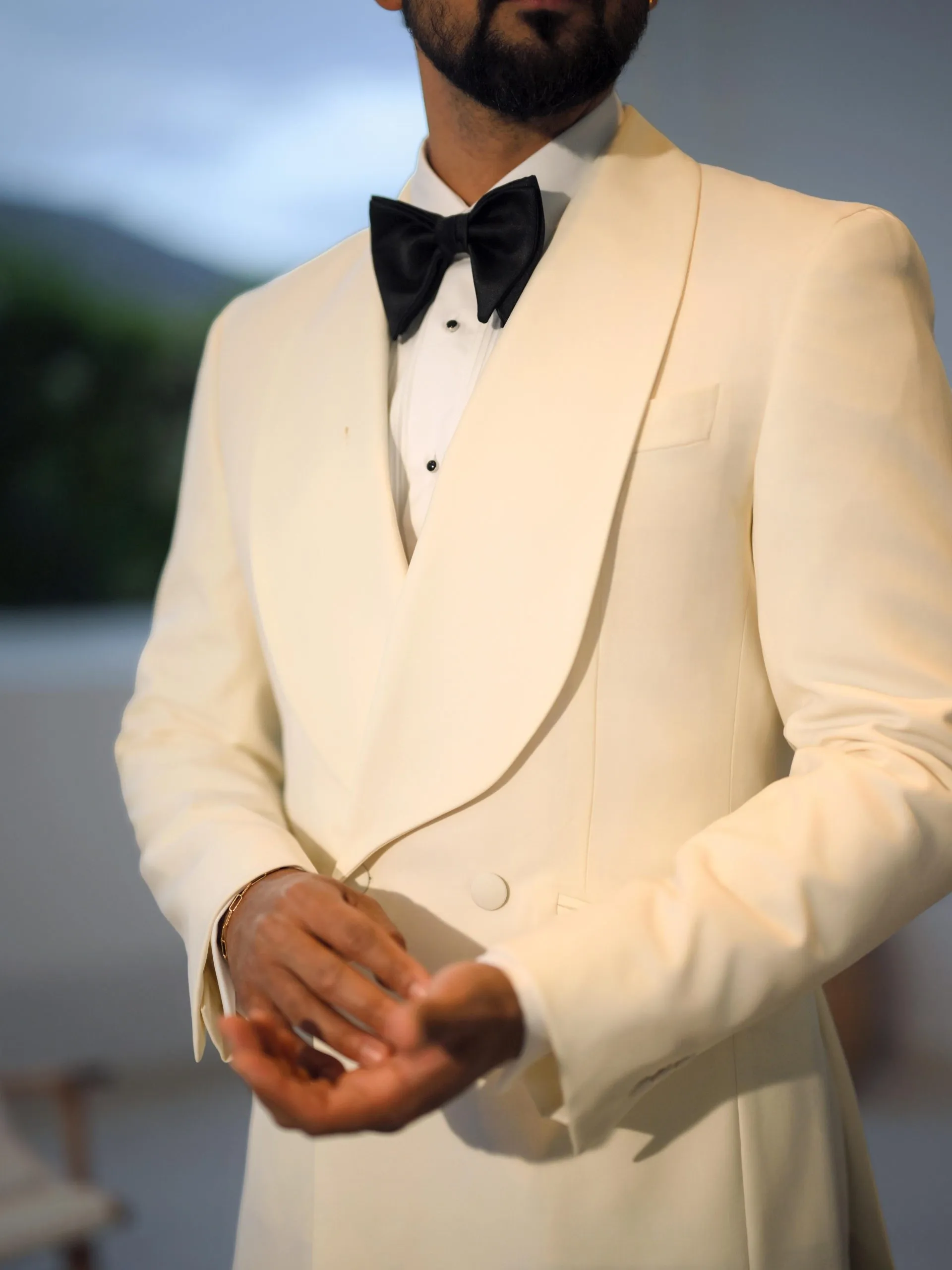
The double-breasted jacket features a generous shawl collar with a low fastening, creating an enveloping silhouette that differs from the sharp notch collar, which introduces a more defined break. The result is a silhouette that is loose-fitting at the top, structured at the shoulders, and tapers towards the waist, covering the cummerbund and the pleated trousers. A construction that flatters both the figure and the movement.
The colour
The ivory or off-white of the jacket set against the black of the trousers and cummerbund creates one of the strongest contrasts possible in black-tie attire. This two-tone combination has been a staple of the summer tuxedo since the 1930s, when evening events on the Riviera and on transatlantic liners dictated a light-coloured jacket over dark trousers. Under artificial light, the jacket captures and reflects light in a way that pure white cannot replicate
A few details
The crossed shawl collar
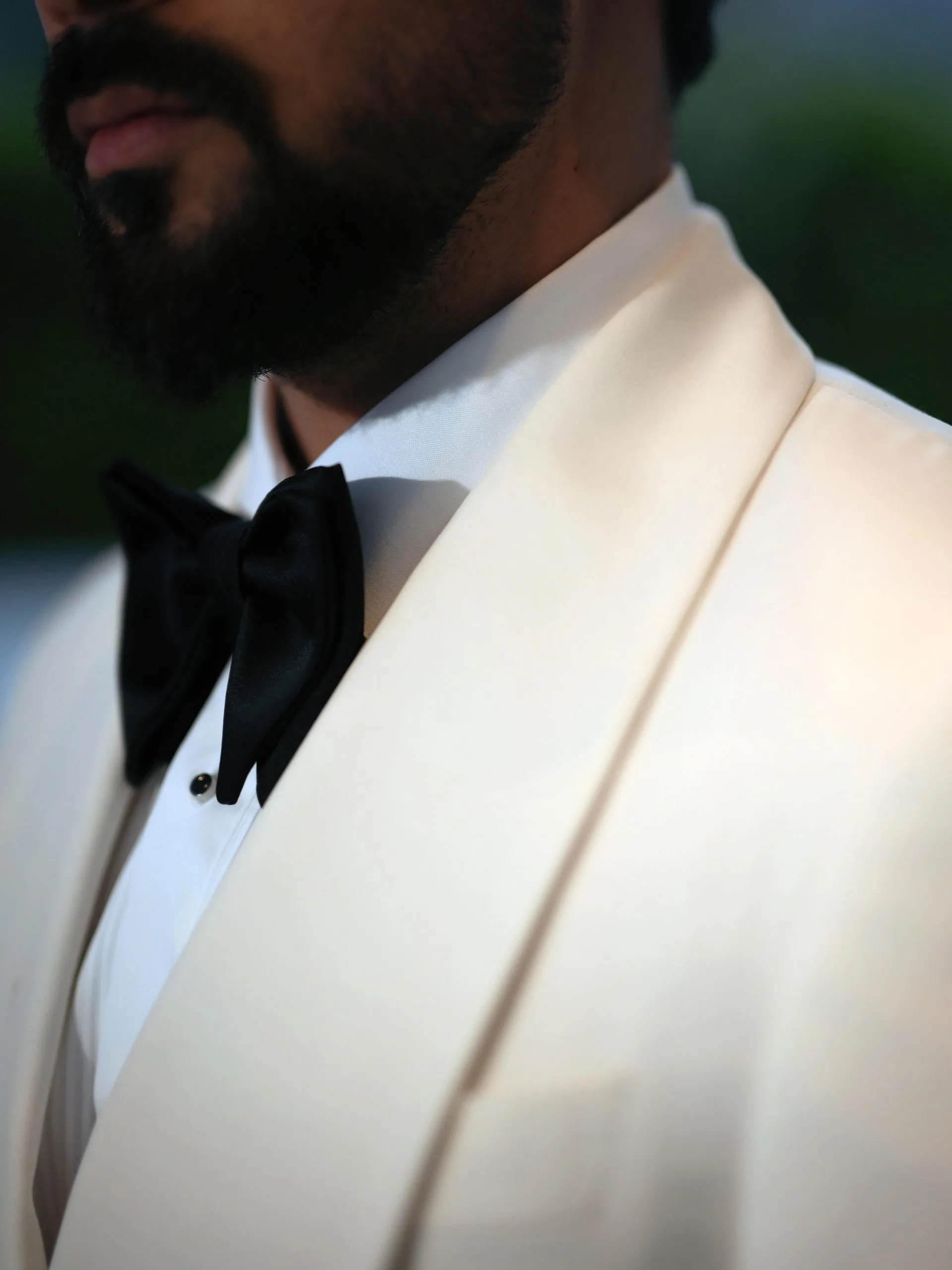
The 9.5 cm shawl collar is very generous without being disproportionate: it covers the shirt collar well, allows the bow tie to be seen in its entirety and curves smoothly down to the bottom button. The shawl collar is entirely matt, uniform and seamless, made from ivory barathéa like the rest of the jacket, whilst the buttons are covered in off-white satin.
The trousers
The trousers feature two outer pleats which add volume around the hips and allow the fabric to move freely. With no back pockets, a high-set waistband without belt loops and braces buttons, the trousers also retain all the traditional features of a tuxedo.
The cummerbund
The pleated silk sash, known as a cummerbund, is the traditional alternative to the waistcoat in a two-piece tuxedo. It has Anglo-Indian origins: adopted by British officers in India in the 19th century as a lightweight alternative to the waistcoat in hot weather, it was incorporated into Western black-tie dress from the 1900s onwards. Here, in black satin, the pleats cover the waistband of the trousers and create a visual continuity between the jacket and the lower half of the outfit, which elongates the silhouette.
Fancy seeing more?
Take a closer look at every detail of Magno Scavo’s Ivory Shawl double-breasted tuxedo.
It’s designed for grand summer evenings, open-air galas and summer ceremonies: a garment that looks just as good under the lights of a gala hall as it does beneath a starry sky.
Wrap shawl
Wrap shawl
The combination of a shawl collar and a double-breasted jacket is one of the most distinctive options for a formal tuxedo.
Business suits
Style
Style
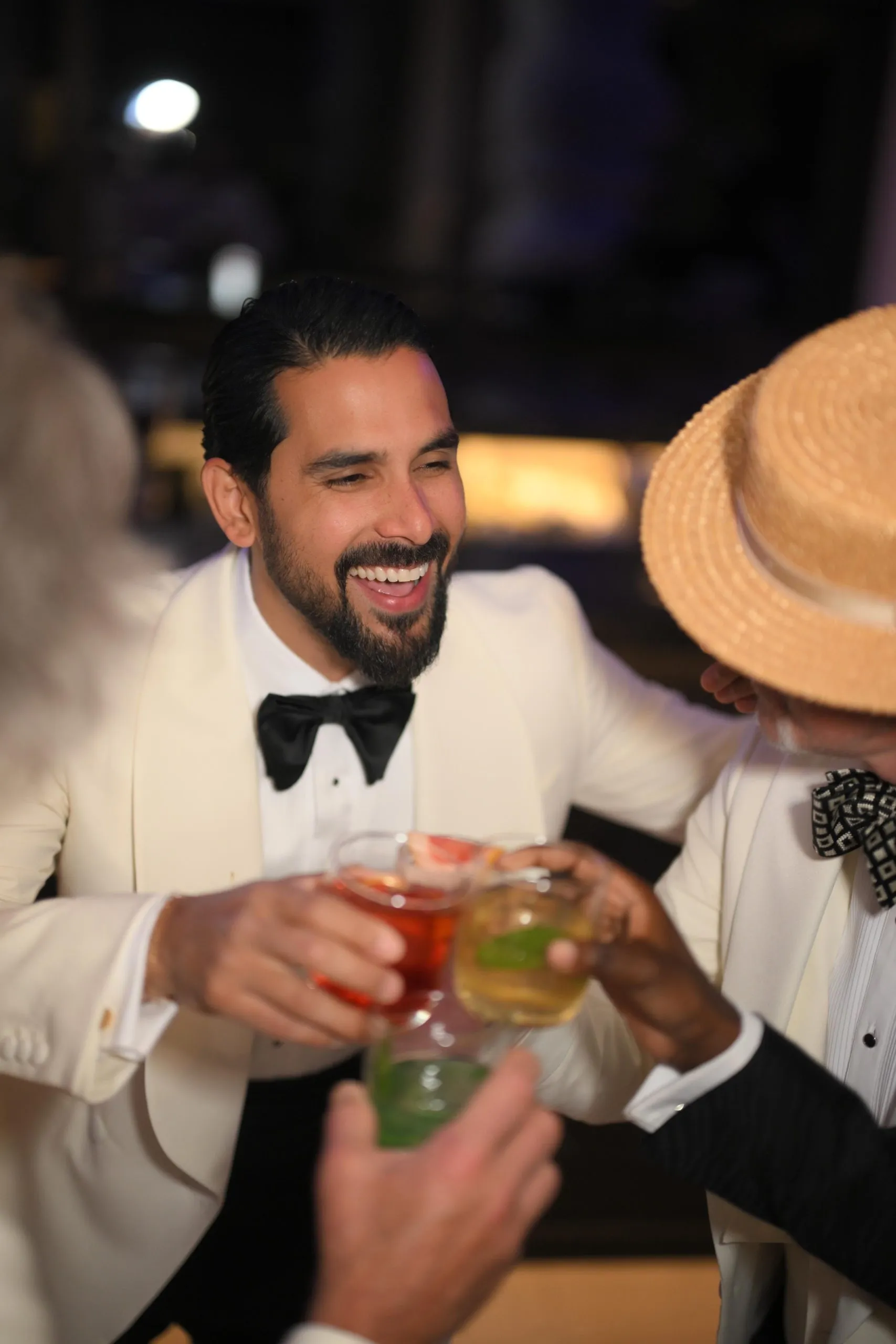
Without the satin on the shawl, the double-breasted jacket takes on a more uniform look. A stylistic choice that replaces the traditional distinction between matt and gloss.
Business suits
Customisations
Customisations
No satin on the lapels and piped pockets, but the off-white satin option could work very well
Business suits
Credits,
Photographer:@thestoryalist